⊞
Mahjong Table Calculator
Enter a headcount, get the table split — including what to do with a number that will not divide by four.
Open the calculator
MahjongTableFlow makes the lesson plans, rosters, seating, rotations and scoring that hold a class, a club night or a tournament together — so the organizing stays out of the game.
Teaching a class, keeping a club organized or running a tournament? Start with the system built for that job.
Explore the full collection →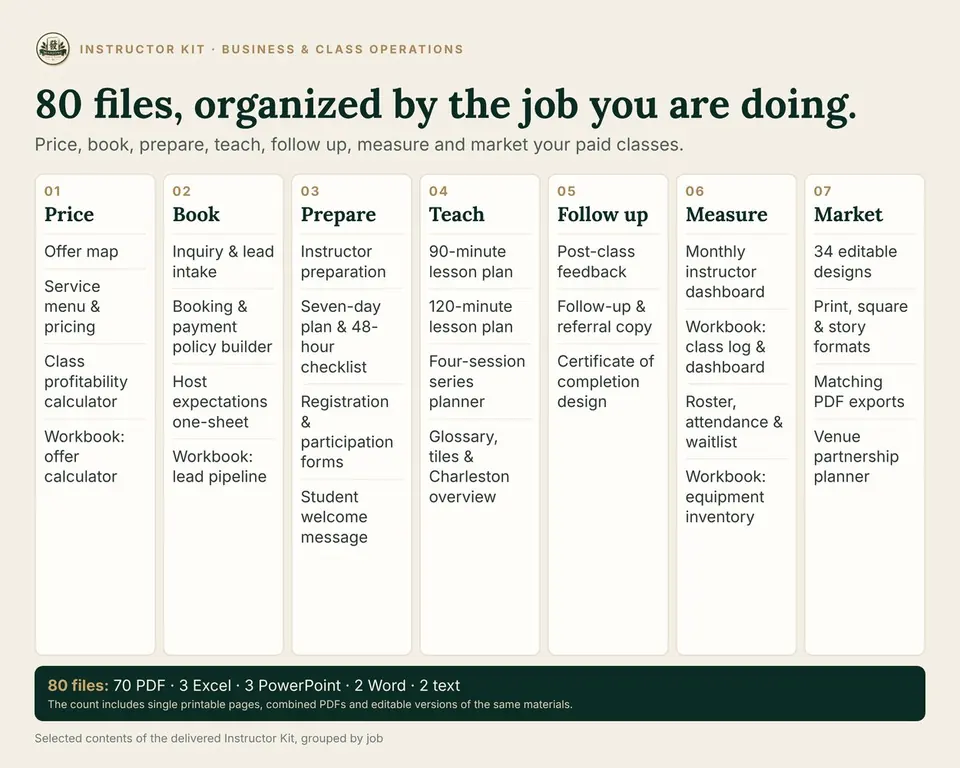 01 / Teach
Digital download
Instructor Kit
Lesson plans, pricing, booking policy, intake forms and class records for paid classes.
You get: 80 files — PDF, Word, Excel and PowerPoint
 02 / Run
Digital download
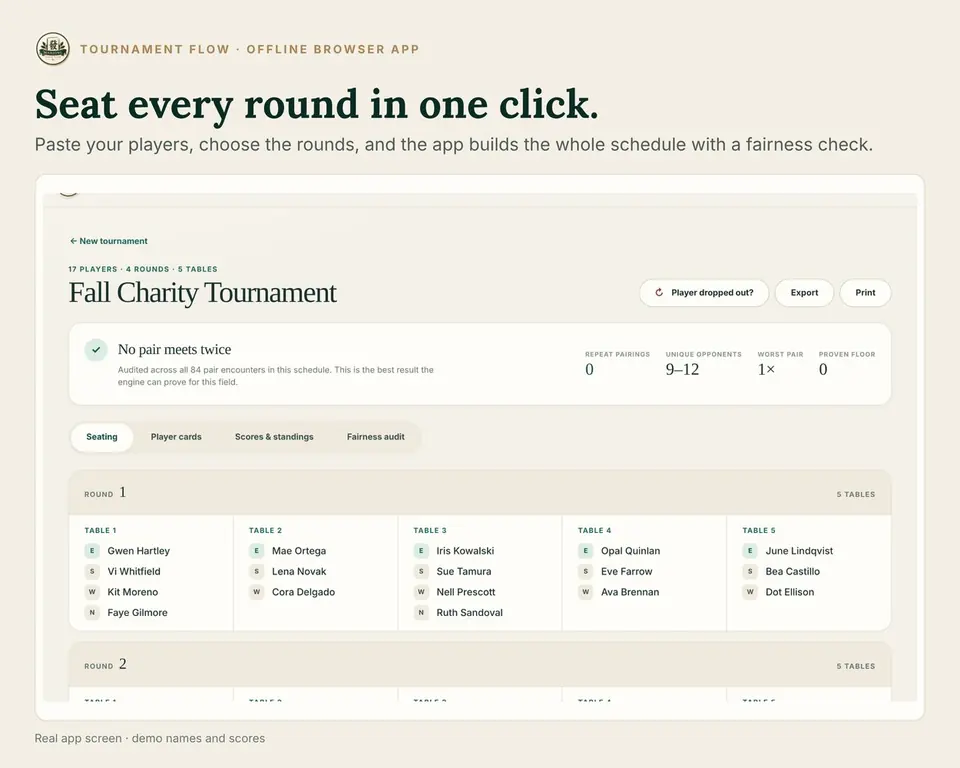
Tournament Flow
Seat every round, track scores and standings. Runs offline on one laptop.
You get: the offline browser app + a 9-page print companion
 03 / Host
Club Organizer
Rosters, rotations and scores for recurring club nights.
→
Someone counts heads. Someone chases the two people who never replied. Someone rebuilds a table when a fourth cancels, reprints last month's score sheet, and tries to remember who still owes for September.
None of that is Mahjong. All of it decides how the night goes.
6:15 — 6:27 PM THE SETUP
Two last-minute cancellations. A table missing its fourth player. Adjust the seating plan without turning the evening into another group chat.
Try the free Club Night PlannerIllustrative scenario · Free to use · No account required
A system doesn't replace your group chat or your spreadsheet. It gives the parts you redo every month one home, so the next session starts from a record instead of from memory.
Four moves sit behind every class, club night and tournament we've built a system for. Each MahjongTableFlow product covers some part of them.
Roster, RSVPs and check-in — know who is actually coming before the first tile is placed.
Lessons, tables and schedules decided in advance, not improvised at the door.
Attendance, rotations and scores handled as the room runs, not reconstructed afterwards.
Results, follow-up and notes saved, so the next session starts ahead instead of from zero.
Choose a seat to see what that person is actually responsible for — and which system was built for them.
You are teaching and running a business in the same ninety minutes. Tonight's session plan, who registered, who has paid and what the next four weeks look like all have to live somewhere other than your head.
See the instructor systemOr go straight to a system: Instructors Clubs Tournaments Social hosts
Both run here, in the page. They use the same seating arithmetic as the free calculators — organizational math, not a Mahjong rules engine.
Five tables: three of four and two of three, which is as even as eighteen gets. Drop one player and watch the seating recompute.
Plan the room, share an invitation, print QR table cards and use a host checklist. Free to use, no sign-up and no monthly payment.
Free online planning. Editable organizer kits are available as one-time purchases.
The questions that come up before you buy anything.
Enter a headcount, get the table split — including what to do with a number that will not divide by four.
Open the calculatorPlayers, tables and rounds in; a high-level event structure out.
Open the plannerA planning estimate for what to charge, based on your own costs and time. Not financial advice.
Open the calculator"The best-run Mahjong room feels easy to the players. The system should carry the complexity, not the host."
Behind a good session are dozens of small decisions: who is coming, where they sit, how tables rotate, what gets printed, how scores are captured and what happens next. Every kit we sell turns one group of those decisions into something reusable.
Products are organized around teaching, hosting and tournament operations — not a generic event planner with Mahjong on the cover.
The paperwork supports the evening instead of becoming the evening.
Rosters, rotations, checklists, score collection and event messages should not be rebuilt every week.
Planning a club night, a first class or a tournament, plus decision practice for the Charleston, the call and the opening rack. Clear steps, named sources, and the tools for the job where they help.

A club night with a plan, not a scramble.
Read the guide
From the first check-in to verified results.
Read the guide
A clear class starts before students arrive.
Read the guideThe maths, plus what to do with an odd number of players.
Read the guide